219 trials audited
248,320 samples
8 sensors
256 Hz
120 automated checks
I set out to train a consumer EEG headset to recognise imagined movement. The training stalled at the console, not at the physics, and the wall turned out to be worth more than the goal.
Independent research on a Neurosity Crown EEG headset, done with hardware loaned by the GFT Labs Digital Innovation Lab. What I built, what I found, and what I'd hand to the next person who picks one up.
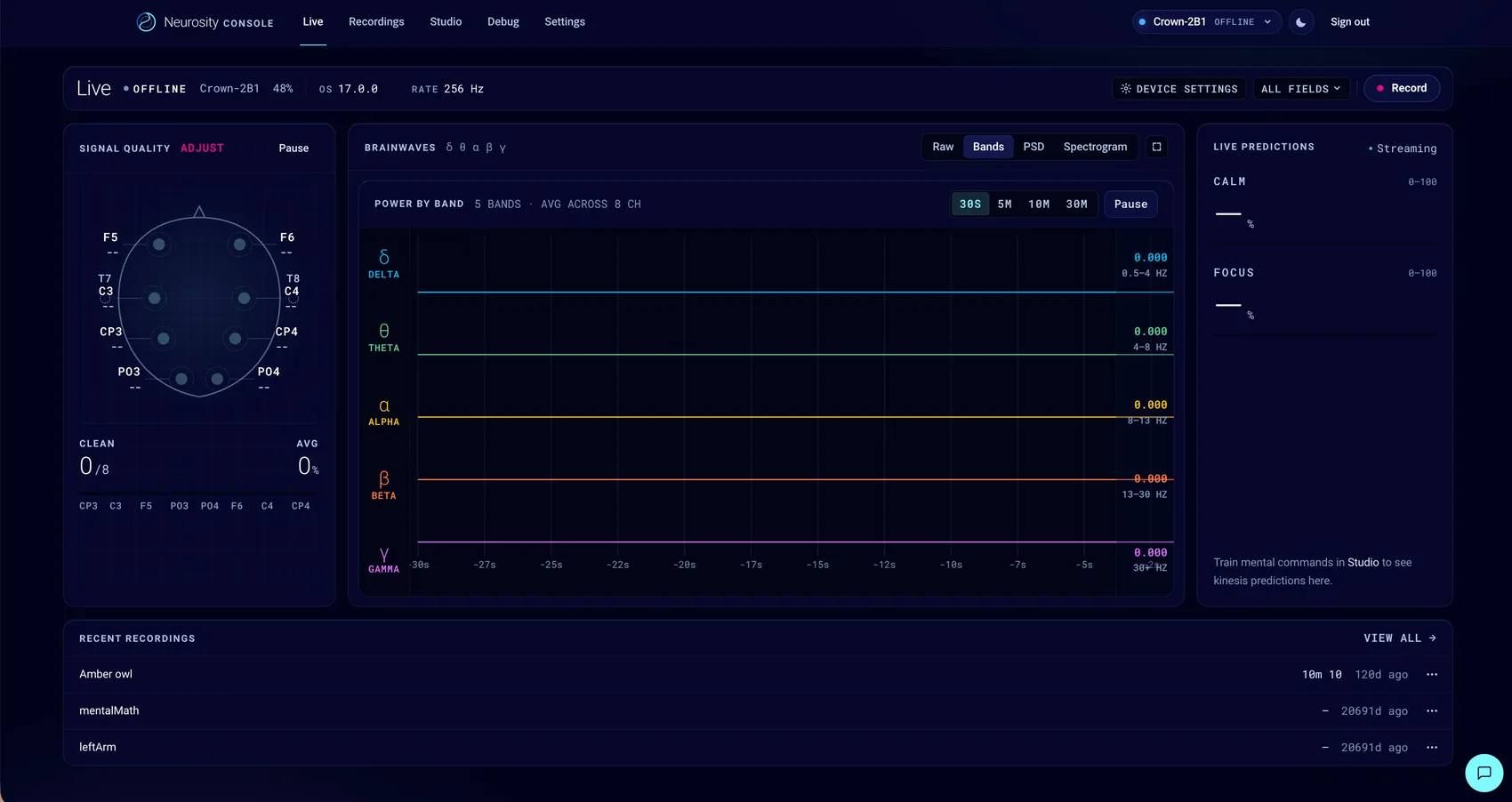
The trials you record are not inspectable, and a model trained on my brain would not transfer to anyone else's anyway. So I pivoted to the thing that does transfer: reading the signal, and writing down what it takes to read it well. The analysis behind every figure here is held in place by 120 automated checks, and the repositories are public.
Alongside the tools, I wrote down everything I learned that isn't in the documentation. This site is that record.
Everything I learned the hard way, the evidence behind the calm score, and a primer for people who have never touched an EEG headset.
15 findings
What they do, how they decide, the judgment calls, and exactly where they stop.
The logger, the debrief, the guide
The whole arc: command selection as a constraint problem, the wall at the console, the pivot, and who this is actually for.
Includes the Signal Reader
The console gives you a screen full of numbers and almost no way to read them. This is what each one means.
12 terms, 5 bands, 3 screens
The tool that turns a recording into plain English, the constraints that shaped it, and the redesign that followed.
Plus redesign and UX audit
What Neurosity already ships, what you would be foolish to rebuild, and the gaps that are actually open.
What is already built
Every way into the headset, for people and for code, and a guide to picking the right one.
Every route in
The project in one place: who ran it, what the headset actually is, and the arc from the training that stalled to the tools that came out of it.
Who made this, and what a Crown isEach one is a post in Findings.


A logger that records sessions to CSV you own.

A debrief that turns a recording into plain English with no AI model in the loop.

A built-in guide that answers questions and cites its sources.
Common questions about this project are answered on the about page.
This site covers what the documentation doesn't: the things I wish someone had handed me first.