A debrief that reports on your session, and a guide that answers questions about it.
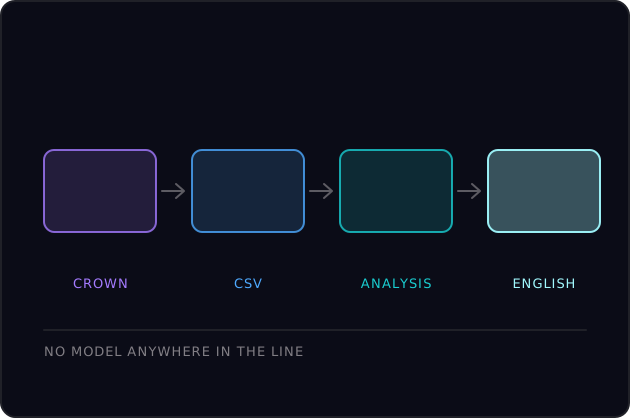
Crown or mock, to CSV on disk, to a set of plain analysis modules, to the debrief and the guide.
I built two tools and a guide. crown-focus-logger records a session to a CSV you own, and crown-debrief reads that recording back and tells you what happened in it: when you peaked, when you crashed, how long your best stretch lasted. The guide answers questions about it for someone who has never seen EEG, citing the note each answer came from. This page covers what they do, their current status, how they decide, and exactly where they stop.
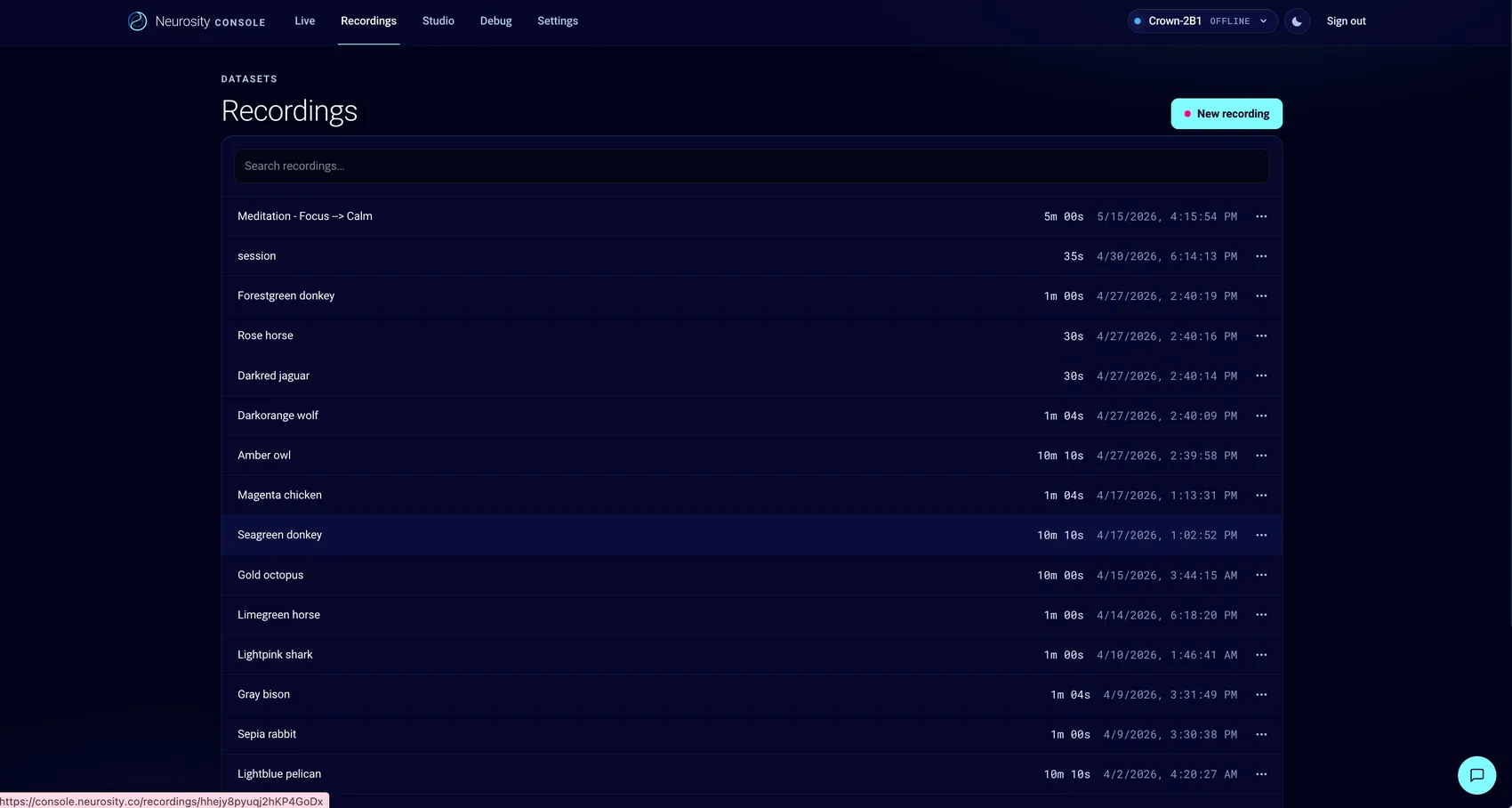
One figure: deep work, the time spent meaningfully above your own normal, in minutes rather than a score.
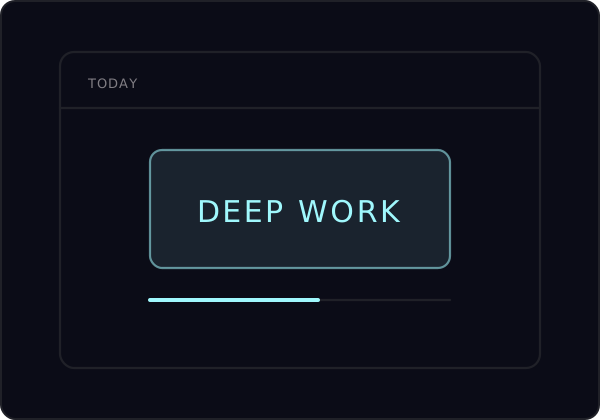
The recording as a state ribbon: named states over time rather than two noisy traces.
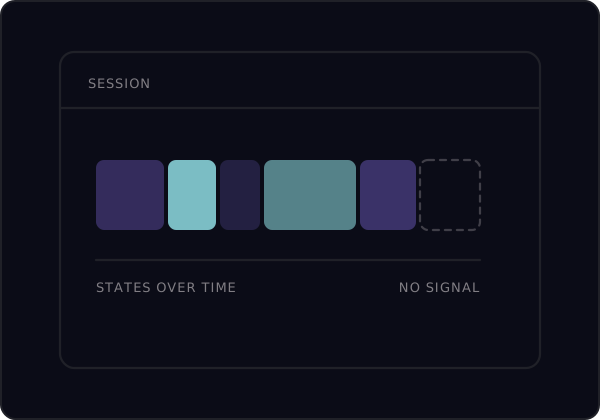
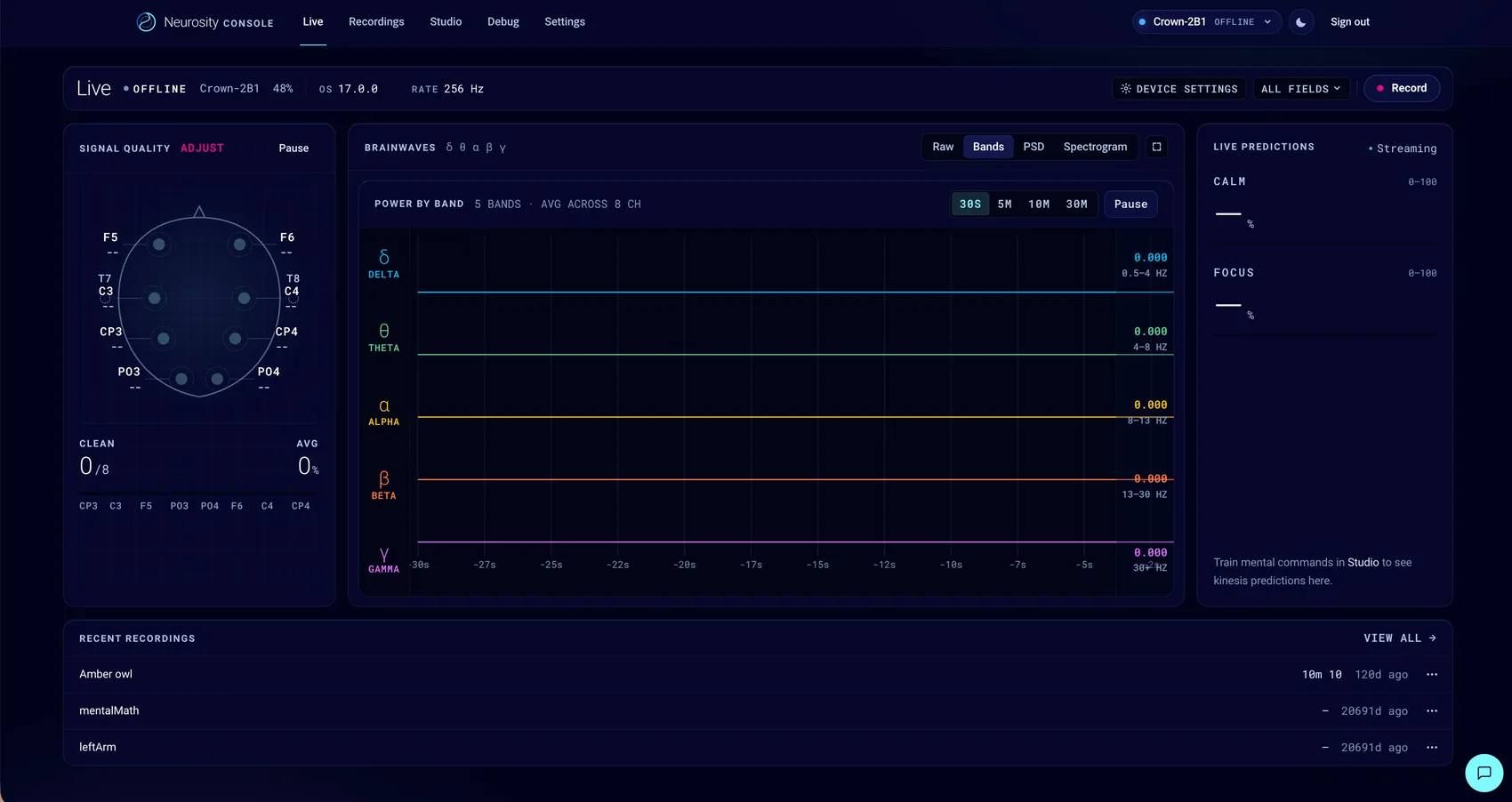
The live stream, band power, electrode contact, and the internals, reached by a quiet link.
Crown or mock, to CSV on disk, to a set of plain analysis modules, to the debrief and the guide.
A plain analysis engine works out the facts, and a set of sentence templates turns those facts into readable English.
Recorded sessions, and any notes written against them, stay on your own machine.
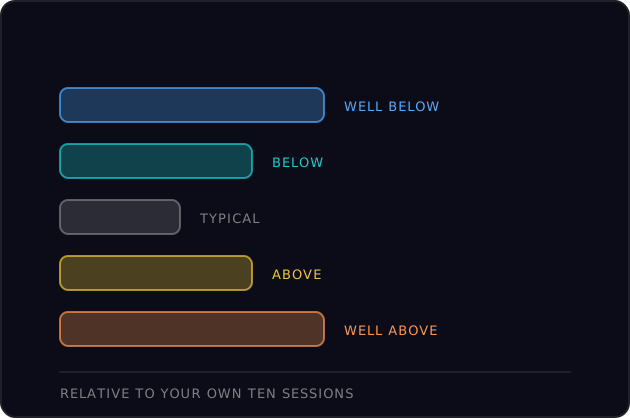
It builds its comparisons from your own history: ten sessions, with norms kept per metric and per hour of day.
One fixed scale describes everything: well above usual, above usual, typical, below usual, well below usual.
Every answer names its source, which note and which section, and nothing goes unattributed.
I demoted the live dashboard on purpose. Trying to hold a mental state while monitoring whether you are holding it works against it, so the primary experience is the debrief you read afterwards.
A poor signal never produces a confident state. The state engine reports "unreadable" rather than guessing.
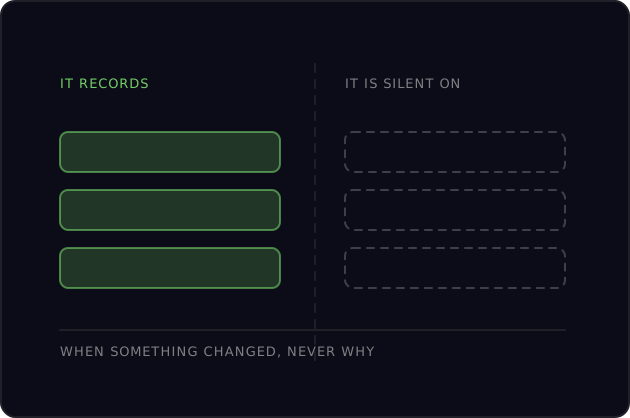
EEG records when something changed and is permanently silent on the cause.
Live mode has never been run against a physical Crown. Everything the interpreter has read came from exported files.
They are computed from band power in these tools and labelled that way everywhere, so they are never mistaken for the vendor's numbers.
Drop in a Crown CSV and read the session, and ask the guide how it all works, entirely in your browser. Nothing uploads.
Two are built and public, one is in progress, and one I stopped. The status here is the status in the repositories.
Records focus, calm and the five bands to a CSV every two seconds, in mock mode or against a Crown.
Built, tested, public. 27 of 27 checks green.
A plain-English reading of every number the Neurosity console puts on screen, term by term.
Built, and shipped into this website rather than the browser extension it started as.
Reads a raw voltage export the console gives you and writes a plain-English account of the session.
Built and public. 120 checks green across two suites, and the pipeline reproduces the console's own channel readouts to within 0.1% on a real recording.
Notes written against a recording, so a later reader can see when fatigue set in and what explains a gap or a change in the data.
In progress.
A conversational assistant answering questions about your own sessions.
Stopped for now. It needs an external model, somewhere to keep fast-accumulating data, and a key, and a public site must not carry a key. What shipped instead is the guide: keyword search over the project's own notes, citing the note each answer came from, with no model in the loop.
Sources. README.md and HANDOFF.md in the crown-debrief repository, the Crown Debrief build specification, and knowledge/reading-your-data.md and knowledge/safety-and-privacy.md.
Common questions about this project are answered on the about page.
This site covers what the documentation doesn't: the things I wish someone had handed me first.