Ecosystem Audit
Ecosystem Audit
A four-phase audit of the Crown platform: what already ships with the headset, which fifteen things you'd be foolish to rebuild, what OSC and LSL mean in plain English, and five consumer products that could live on top. Every factual claim carries its provenance.
Neurosity Crown Ecosystem Audit · Crown 3
What’s already built, and what’s left to build
A four-phase audit of the Crown platform: what already ships with the headset, which fifteen things you’d be foolish to rebuild, what OSC and LSL mean in plain English, and five consumer products that could live on top. Every factual claim carries its provenance.
Claims are tagged by how well I could ground them. Nothing here is inferred.
Verified stated on a Neurosity page or in their docs
Ambiguous sources conflict, or status unclear
Unknown not published anywhere I could reach
The loaned device, as the API reports it›
Pulled live from the Neurosity account the Crown was loaned on, so the rest of this document is grounded in the actual hardware rather than a spec sheet.
| | |
| --- | --- |
| Device | Crown-2B1 |
| Model | Crown 3 |
| Channels | 8 |
| Sampling | 256 Hz |
| OS | 17.0.0 |
| | |
| --- | --- |
| activityLogging | ON |
| hapticsSystem | ON |
| osc | OFF |
| oscBatch | OFF |
| oscPerform | OFF |
| lsl | OFF |
| supportAccess | OFF |
Electrodes sit at CP3 · C3 · F5 · PO3 · PO4 · F6 · C4 · CP4, frontal, central and parieto-occipital. Good coverage for attention and alpha; no temporal or true prefrontal sites, which matters if you were hoping to do emotion or drowsiness work.
Part 01, Phase 1
What ships with the headset, and what is left to build
Neurosity does not gate the data. Raw EEG and the full SDK come with the hardware, so the thing left to build is interpretation, not access.
| Capability | Grounding |
|---|---|
| Raw EEG @ 256 Hz | Verified FAQ: raw EEG, FFT, PSD, signal quality, accelerometer |
| Focus / Calm scores | Verified included in the API and the mobile app |
| Kinesis (motor imagery) | Verified trained in the Console; docs state no access restriction. Labelled experimental, with known lag and accuracy limits |
| iOS / Android app | Verified listed on the App Store, v2.1.8 |
| Hosted online demo | Verified hosted simulator with Console and SDK access; login sent by email |
| Developer Console | Verified visualisation, raw recording, Kinesis training, settings |
| JS / Python / Dart SDKs | Verified all three documented and openly available |
| OSC, LSL, BrainFlow, WebSockets, MCP | Verified all listed as included protocol support |
| NeuroAdaptive Audio & Meditation | Verified bundled in the mobile app |
| Neurosity Music (Spotify) | Ambiguous described as a beta |
| Device Emulators | Verified virtual EEG machines running the Neurosity OS, created from the Console |
| 4-week developer course | Verified runs in small monthly cohorts |
What this means strategically›
Three consequences follow directly, and they should shape everything downstream:
-
There is no gate to route around. Nothing is withheld that a wrapper could unlock, so anything built on top has to offer interpretation, habit, or time saved, never the data itself.
-
There is no marketplace. Neurosity runs none, which means anything built here owns its own distribution entirely. That is freedom and it is also the whole burden of reaching anyone.
-
The openness is the argument, and it is not yours. Competing headsets withhold raw EEG and session history from their own users; the Crown does not. That is the strongest thing to point at, and it is the vendor’s decision rather than yours, which means it can change.
Part 02, Phase 2
The do-not-rebuild map
Fifteen categories where mature software already exists. Each row is a place where a first version would take you weeks and buy you nothing.
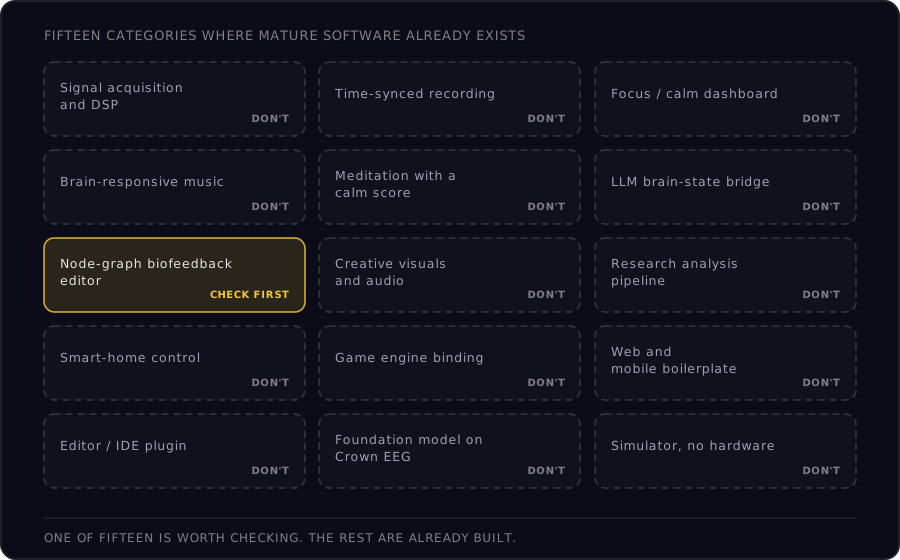
| If you were going to build… | It already exists as | Verdict |
|---|---|---|
| Signal acquisition & DSP | BrainFlow, CROWN_BOARD, NOTION_1_BOARD, NOTION_2_BOARD are first-class supported boards on Windows, macOS, Linux and Raspberry Pi. Filters, denoising and ML helpers included. Also Neurosity’s own eeg-pipes (RxJS) and dsp.js. | Don’t |
| Time-synced multi-stream recording | Lab Streaming Layer plus LabRecorder and the XDF format. Solves clock sync, buffering and discovery across machines. | Don’t |
| A focus/calm dashboard | The Neurosity Console and the mobile app. This is the single most-rebuilt thing in the whole ecosystem. | Don’t |
| Brain-responsive music | NeuroAdaptive Audio in the app, plus the Neurosity Music Spotify beta. This is the incumbent’s flagship feature. | Don’t |
| Meditation with a calm score | NeuroAdaptive Meditation, first-party. | Don’t |
| An LLM / AI brain-state bridge | Neurosity’s official MCP server already pipes live focus, calm, raw brainwaves, signal quality and haptics into Claude and ChatGPT. It is what read the device settings for this report. | Don’t |
| A node-graph biofeedback editor | neuromore Studio, open-source, takes Crown-family data over OSC on port 9000. | Check first |
| Creative visuals / audio output | TouchDesigner, Max/MSP, Ableton, Resolume, Unity, Processing all speak OSC natively. You do not need a canvas; you need a mapping. | Don’t |
| Research analysis pipeline | MNE-Python, EEGLAB, FieldTrip, reachable through LSL and BrainFlow. | Don’t |
| Smart-home / lighting control | Neurosity’s demo-notion-nanoleaf, plus community Home Assistant and MQTT bridges. | Don’t |
| Game engine binding | notion-unity, the JS SDK ported to C# for Unity. | Don’t |
| Web / mobile boilerplate | neurosity-react-web-starter, neurosity-next-web-starter, neurosity-react-native-starter, neurosity-node-hub-osc-starter. | Don’t |
| An editor / IDE plugin | plugin-vscode-notion already exists, and your brief rules these out anyway. | Don’t |
| A foundation model on Crown EEG | EEG-GPT and sw-kinesis-ai are Neurosity’s own R&D. You will not out-model the vendor on their own data. | Don’t |
| A simulator for building without hardware | notion-osc-server (open source) and Neurosity’s official Device Emulators. | Don’t |
The neuromore caveat
Its device documentation lists Notion and Notion 2, with “Crown coming soon”, and flags a known signal-drift issue where the stream may not stay consistent. That documentation may be stale, but verify Crown 3 support yourself with a short test before you build a workflow around it.
The gaps that are actually open›
Where nothing exists yet
No consumer product uses OSC Perform Mode. Everything reading that stream today is developer- or artist-facing. The single most consumer-ready data feed on the device has no consumer product on it.
No cross-session normalisation layer exists. Nobody has built the thing that makes a focus score mean the same thing on Tuesday as it did on Monday. This is discussed in Part 05 because it is, in my view, the actual defensible asset.
Nothing gates on signal quality for a non-technical user. Every tool shows numbers whether or not the electrodes have contact.
The two haptic motors are an unclaimed output channel. No shipping consumer product uses them for feedback.
Clinical neurofeedback software ignores the Crown entirely. BrainPaint, EEGer, NeuroGuide, BioExplorer and Cygnet are all locked to BrainMaster, Mitsar or Deymed amplifiers. That is a real gap, and a heavy lift with regulatory exposure. I would not start there.
Part 03, Phase 3
The protocols, in English
UDP port 9000: the postcard, not the phone call›
MIDI's modern descendant"] U --> L["LSL
the research lab's courier"] O --> M["Music, lighting and visual tools"] L --> R["Recording and analysis software"]
TCP, which carries most of the internet, is a phone call: you connect, you confirm, and anything lost gets sent again. UDP is a postcard. You drop it in the box and never find out whether it arrived.
For brainwaves that is the correct trade. A packet describing your brain sixty milliseconds ago is worthless; you would rather lose it than wait for it. So the Crown fires postcards and never looks back. Port 9000 is simply the conventional door number that OSC software listens at, TouchDesigner, neuromore and the rest all default to it.
The consumer-facing consequence is the important part: this only works on the same Wi-Fi network, it relies on broadcast, and firewalls or campus networks routinely block it. BrainFlow’s own documentation warns about exactly this. Hold that thought for Part 05.
OSC: MIDI’s modern descendant›
Open Sound Control was invented so musicians could wire instruments and software together over a network. A message is just an address and some values, like a file path with a number attached:
-
/crown{deviceId}/alpha, your alpha band power -
/crown{deviceId}/signalQuality, how good the electrode contact is -
/crown{deviceId}/battery, charge remaining
A developer reaches for OSC when they want the Crown to drive something in the same room, right now, lights, a synth, a projection, a game. It is the lowest-friction path from a brain to a visible effect, and it requires no SDK at all in the receiving application.
LSL: the research lab’s courier›
Lab Streaming Layer answers a different question. In a study you might record EEG, eye-tracking, a heart monitor and a stimulus program on four machines, and later you need to know which happened first, to the millisecond. LSL streams announce themselves on the network, carry synchronised timestamps, buffer against hiccups, and are read from C++, Python and MATLAB.
The one-line difference
OSC is for making something react. LSL is for proving something happened. If losing a packet would ruin your result, use LSL. If losing a packet just means one frame looked slightly wrong, use OSC.
Perform Mode vs. Batch Mode›
| OSC Perform Mode | OSC Raw / Batch Mode | |
|---|---|---|
| What arrives | Interpretations: power bands, focus and calm probability, signal quality, battery | The unprocessed signal from all 8 electrodes |
| How often | 4 messages / second | 256 Hz, packed 16 samples per channel per packet (~62.5 ms) |
| Smoothing | Power bands are averaged over a 16-second sliding window | None, every sample as measured |
| Bandwidth | Trivial. Runs on anything. | Heavy and continuous. |
| Built for | Anything a person looks at or feels | Machine learning, research, custom signal processing |
| Your move | This is the consumer stream. Every idea in Part 04 runs on it. | Only if you are training your own model. |
Why “batches of 16”? Sending one network packet per sample would mean 256 packets a second per channel, and the packet overhead would dwarf the data. Bundling 16 samples into one message means fewer, fatter packets and far less waste. It is an efficiency choice, not a different kind of data.
And the sixteen-second window on Perform Mode is a feature, not a limitation. It means the number will not twitch. You can bind it directly to something visible without any smoothing of your own, a raw focus score would flicker so much it would be unusable in a UI.
An inference I am flagging rather than asserting
Neurosity’s OSC documentation names exactly two modes, Raw and Perform. Your console and the settings API expose three flags: osc, oscBatch and oscPerform. Mapping oscBatch onto the raw-batched stream is my reading of the docs’ description of 16-sample batches, it is not a documented statement. If oscBatch turns out to be an independent toggle that changes packing on either mode, some of the table above shifts. A ten-minute test with both flags on and a packet sniffer would settle it.
The three settings nobody talks about›
Activity Logging (currently on for you) writes periodic focus and calm metadata snapshots. It needs no network configuration, no port, no same-Wi-Fi requirement, and it is the cheapest data source on the entire device. It is also the one almost nobody has built a consumer product on.
System Haptics (currently on) drives two motors sitting at P7 and P8 on the 10-10 electrode map, back left and right side of your head. You can queue up to seven named effects in a single command, things like strongClick100 or transitionRampUpLongSmooth1_0_to_100. This is an output channel with no consumer product using it.
Support Access (currently off) grants Neurosity’s support team temporary access to your device. Leave it off unless you are actively in a support ticket.
Part 04, Phase 4
Five things worth building
All five run on Perform Mode or Activity Logging. None of them is a dashboard, because the Console is already a dashboard. The organising principle is that a chart is a bill for work the user still has to do. A consumer product should have already done the interpreting.
Doorman›
Perform Mode
Highest leverage
Your notifications learn to read the room.
A background service, not an app. When Perform Mode says you have been in focus for a few minutes, it silently turns on your OS focus mode, sets your Slack status, and locks the sites you named as distractions. When you drop out, everything quietly reopens. The entire interface is one toggle and a settings screen you visit once.
Reads
Focus probability, signal quality
Screen time
Near zero, by design
Why they care
It is the only product here that gives back time instead of asking for it. Nobody has to learn what alpha means.
Weight
Medium, the OS integrations are more work than the EEG side
Risk
A false positive locks someone out of a site they genuinely needed. Needs a fast, guilt-free override.
Brain Weather›
Activity Logging
Most defensible
A forecast, not a report card.
Activity Logging quietly accumulates for a fortnight, then the product starts making claims: “Your sharpest window is 09:40 to 11:20. You have three meetings inside it this week.” It writes the protected block into your calendar itself. The weekly view is a climate summary in sentences, not a line chart, the metaphor does the explanatory work that a legend would otherwise have to.
Reads
Activity Logging only, no OSC, no ports, no Wi-Fi setup
Screen time
Ninety seconds a morning
Why they care
It makes a decision for them. “Move this meeting” is actionable; “68% focus” is not.
Weight
Light to build, but it needs weeks of data before it says anything true
Risk
Overclaiming from thin data. Say nothing until the pattern is real, and show the confidence.
Down›
Perform Mode
Haptics
Meditation feedback you feel, with your eyes shut and your phone face down.
The calm score drives the two haptic motors and nothing else. As you settle, the pulses slow and soften; if you drift, a gentle asymmetric tap on one side brings you back. No screen, no audio, no voice. Sessions end with a single sentence, and that sentence is the whole report.
Reads
Calm probability → haptic effect queue
Screen time
Literally none during a session
Why they care
Every competitor’s feedback is audio or visual, and both compete with the state you are trying to reach. Touch does not.
Weight
Light, the haptics API takes queues of up to seven effects
Risk
Neurosity’s own NeuroAdaptive Meditation is adjacent. The screenless, touch-only stance is what keeps this a different product rather than a worse copy.
The Session Card›
Activity Logging
Cheapest to ship
Strava for deep work.
You finish a work session and get one card: how long you held focus, your longest unbroken stretch, whether it beat your record, and where it sits in your streak. Designed to be screenshotted. The social layer is the product; the EEG is just the thing that makes the number credible where a self-reported timer is not.
Reads
Activity Logging only
Screen time
Ten seconds, after the fact
Why they care
Streaks and personal records are a proven retention mechanic, and this is the only honest version of them, you cannot fake it.
Weight
Lightest here. A viable weekend prototype.
Risk
Comparison between people is meaningless without normalisation. Keep it strictly you-versus-you.
Tell›
Perform Mode
Ambient
One shape in your menu bar that quietly knows how you are doing.
Not a dashboard, a single glyph. It breathes slowly when you are settled, tightens when you are focused, and goes hollow when contact is poor so you know to adjust the headset. No numbers anywhere in the interface. A soft haptic tap arrives if you have been out of focus for a few minutes, and that is the only thing it ever asks of you.
Reads
Focus, calm, signal quality
Screen time
Peripheral only
Why they care
It is the gentlest possible introduction to neurofeedback. Nothing to interpret, nothing to learn.
Weight
Light, though the glyph design is the whole product and will take real iteration
Risk
Ambient products are easy to ignore into oblivion. It needs the haptic nudge to stay alive.
If you build one thing
Build The Session Card first because it is a weekend and proves the data pipeline, then Doorman because it is the only one where the value is obvious to someone who has never heard of EEG. Brain Weather is the one worth owning long-term, because its advantage compounds with every week of a user’s history and cannot be cloned by a competitor on day one.
Part 05
Strategic improvements & unconsidered opportunities
Eight things outside the brief that I think change the shape of the decision.
1. The scores are relative. The normalisation layer is the real product.›
Focus and calm are probabilities, not measurements, and your personal baseline drifts with headset fit, hydration, caffeine and time of day. A product that displays a bare “68% focus” is presenting noise as precision. Higher leverage because the per-user baselining and drift-correction layer is the only piece of this stack nobody has built, it gets better with data, and it is the thing that would make every one of the five concepts above actually trustworthy. It is the moat, not the UI.
2. Build the signal-quality gate before you build anything else.›
Consumer neuro products mostly die the same way: they confidently display numbers derived from an electrode that lost contact ten minutes ago, the user notices it is nonsense once, and never trusts it again. Higher leverage because Perform Mode ships signal quality in the same stream for free, and a product that says “I can’t read you right now, adjust the band” earns more credibility than one that always has an answer.
3. Do not ship a consumer app on OSC. Ship it on the SDK.›
OSC needs the same Wi-Fi network, working broadcast, and a firewall that permits it, BrainFlow’s docs warn that university networks routinely break it. That is an unsupportable onboarding flow for a non-technical user. Higher leverage because the SDK and MCP paths carry the same Perform-grade metrics without any network configuration. Reserve OSC for the one case it is genuinely best at: driving something creative in the same room.
4. Build on BrainFlow and your market multiplies.›
The Crown’s install base is small. The same product built against BrainFlow or LSL also runs on Muse, OpenBCI and others. Higher leverage because it costs little at the start and almost nothing extra later, it expands your addressable market by an order of magnitude, and it removes the risk of your entire business depending on one small hardware company’s roadmap.
5. The MCP server may be a better interface than any app you could design.›
For a non-technical person, asking “how was my focus this week?” and getting a sentence back beats any chart you could draw. That capability already exists and is what read your device settings for this document. Higher leverage because you could ship your product as a set of MCP tools plus a thin surface, skip most of the UI build entirely, and reach users inside an assistant they already open every day.
6. Haptics is an open category and everyone is ignoring it.›
Two motors, a documented effects API, and not one shipping consumer product using them. Higher leverage because every competitor gives feedback through sound or screen, both of which interrupt the exact state the user is trying to hold. Silent, eyes-free feedback is a genuinely unoccupied position, and it is cheap to prototype.
7. Stay clear of clinical language.›
The moment your copy mentions ADHD, anxiety, depression or treatment, you are in territory regulators care about, and consumer EEG has drawn attention before. Higher leverage because the framing costs nothing to get right at the start and is expensive to retrofit: sell measurement and habit, never therapy. Worth a real legal opinion before launch.
8. Ask what survives if Neurosity’s cloud does not.›
You would be building on one venture-funded company’s infrastructure. OSC and LSL are local and would keep working; the SDK’s cloud path would not. Higher leverage because deciding now whether your product degrades gracefully or dies outright is a one-hour architecture conversation, and an unrecoverable one later.
My own ranking is that (1) normalisation and (4) device-agnosticism change what the project is, while (2) signal-quality gating and (3) dropping OSC change whether a first version works at all.
Part 06
What I could not confirm
Stated plainly, so nothing here gets mistaken for fact:
-
What
oscBatchdoes precisely. Not documented as a named mode. My mapping is inference; testing would settle it. -
Whether neuromore Studio supports Crown 3 today. Its docs say “coming soon” for Crown and flag a drift issue. May be stale.
-
Named community projects. Neurosity’s own community round-ups describe categories rather than naming repositories, so my Part 02 inventory comes from their GitHub organisation directly and is not exhaustive.
Part 07
Sources
-
Neurosity, FAQ (raw EEG, Kinesis, apps)
-
Neurosity SDK docs, OSC (port 9000, Raw & Perform modes, 16-sample batches, 16-second window)
-
Neurosity SDK docs, Haptics (P7/P8 motors, 7-effect queue)
-
Neurosity, Developers (SDK, Console, Emulators, course)
-
Neurosity, Crown vs OpenBCI (included software, protocol list)
-
Neurosity, Crown alternatives (competitor comparison)
-
Neurosity, Crown vs Muse S (Muse feature comparison)
-
Neurosity, Neurofeedback software compared (clinical platform lock-in)
-
Neurosity, Best use cases (MCP server)
-
BrainFlow, Supported Boards (CROWN_BOARD, broadcast/firewall caveat)
-
neuromore Studio, Devices wiki (OSC 9000, “Crown coming soon”, drift)
-
Neurosity GitHub organisation (SDKs, starters, eeg-pipes, EEG-GPT, notion-unity)
-
Neurosity on the App Store (v2.1.8)
-
Live device readout via the Neurosity MCP connector on this account.
Ecosystem audit · Crown 3 · every claim tagged by provenance
Explore more
This site covers what the documentation doesn't: the things I wish someone had handed me first.