About
Independent research using hardware loaned by the GFT Labs Digital Innovation Lab. What I built, what I found, and what I would hand to the next person who picks one up.

trials audited
samples
sensors
sampling rate
sessions read

Who made this
I'm Samantha Lin. I'm a Master's student in Human Computer Interaction at Elisava School of Design and Engineering, and I worked with the GFT Labs Digital Innovation Lab, who loaned me a Neurosity Crown so I could find out what it does.
My first degree was a Bachelor's in Psychology with a minor in Sociology, and the research training from it turned out to matter more for building on the Crown than anything in the EEG textbooks: what the literature actually supports, and where the honest line sits between a published finding and my own reasoning. That habit runs through everything here. Where a claim is mine rather than the literature's, I say so.
This is independent research using hardware loaned by the GFT Labs Digital Innovation Lab, and it feeds my own thesis project. My part was hands-on and self-directed. I set the training protocol, ran the sessions, audited what came back, and wrote the tools that read it.
The pivot away from training the headset was not a quick decision. I had 219 trials recorded and a protocol I still think was right, and the honest reading of the situation was that continuing would produce a model only I could use, built on trials I could never open and check. Stopping cost me the goal I had started with. What it bought was every finding on this site, which is the part that transfers to anyone else who picks up this hardware. A logger, crown-focus-logger, records sessions to CSV you own. A debrief, crown-debrief, turns a recording into plain English with no AI model in the loop. A built-in guide answers questions about a session and cites its sources. Alongside the tools I wrote down everything I learned that is not in the documentation.
What that came to: 219 training trials across 17 experiments, three recording sessions read closely, 248,320 samples of raw voltage, and two tools plus a guide for turning a session into something a person can read. The whole arc, including the wall I hit and the pivot it forced, is in the case study.
More of my work: samanthalin130@gmail.com and LinkedIn.
Where this came from
My Master's thesis project is AuraPod AI. The Crown entered that work as the way to measure my own neurophysiological state accurately enough to pair with it, rather than as a subject in its own right.
This site is the loaned-hardware research that grew out of that pairing. Once I started trying to read the signal properly, the reading turned out to be the harder and more useful problem.

What a Neurosity Crown is
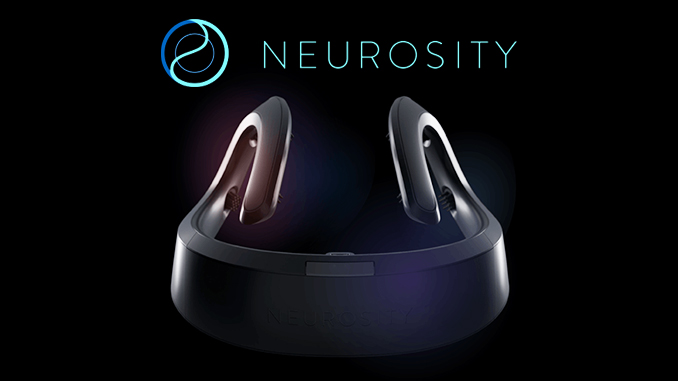
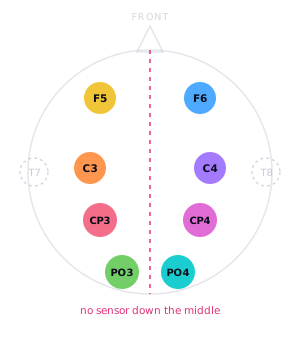
The Crown is a consumer EEG headset, a Crown 3 in this case: eight dry recording electrodes resting against the scalp, sampling at 256 times a second. Dry means no gel and no preparation, which makes it quick to put on and more sensitive to how well it is sitting. It is not a medical device, and nothing on this site is a health assessment.
Two things come out of it. The raw signal, eight channels of microvolts, which you can record and export yourself. And two scores, focus and calm, which are not measurements: they are the output of models trained on other people, delivered as a probability between 0 and 1.
It also ships with a training feature. You pick a command like "left hand pinch," record yourself imagining it thirty times, and a model on Neurosity's servers learns to spot that pattern in your live signal. That feature is where this project started, and where it stalled.
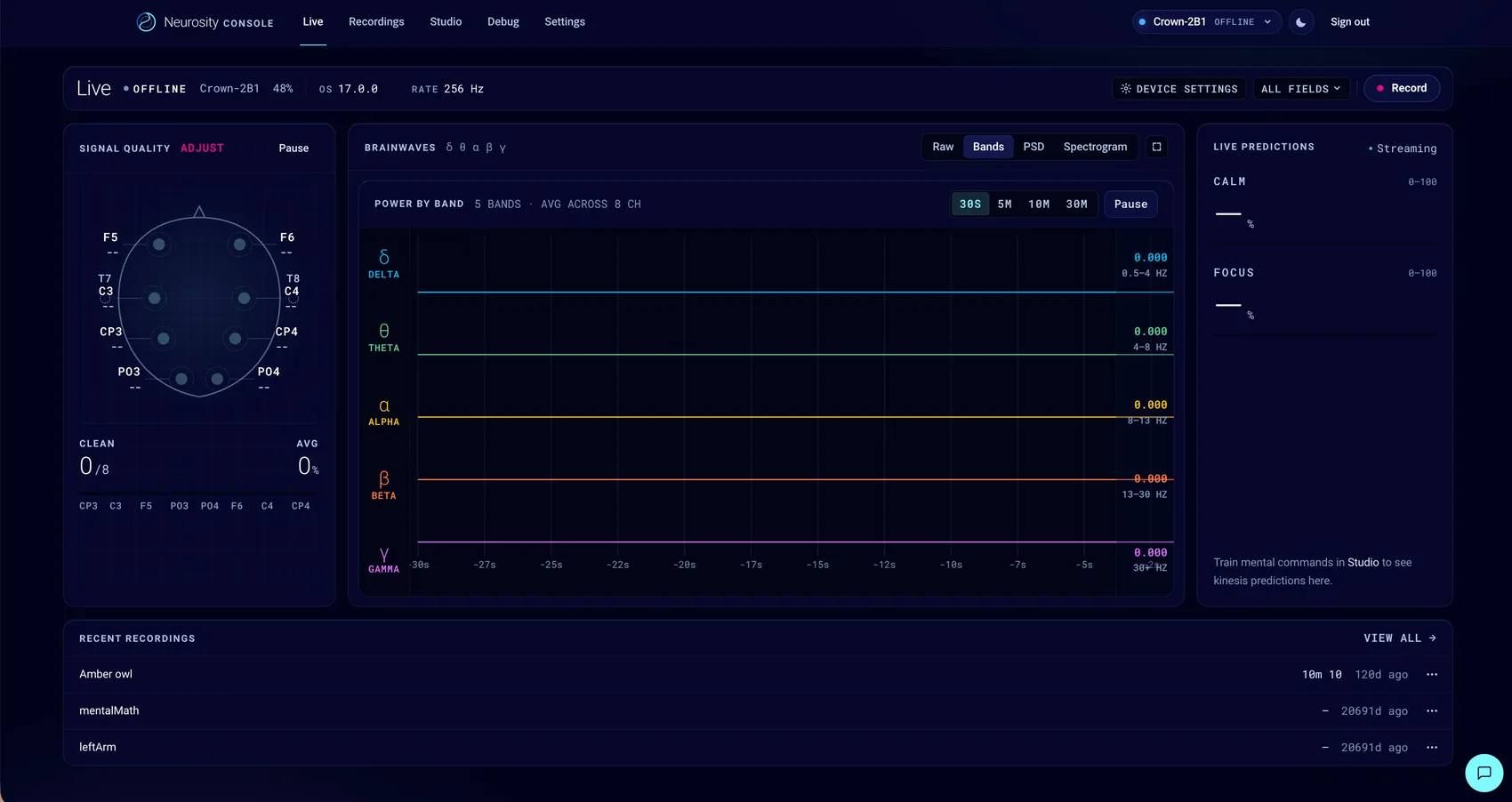
Official Neurosity documentation covers the setup, the API, and the numbers, at docs.neurosity.co. This site covers what the documentation doesn't: the console screen by screen, which is also where the vendor's own figures are kept, and the things I wish someone had handed me first.

Questions, answered
Decode the consoleExplore more
This site covers what the documentation doesn't: the things I wish someone had handed me first.