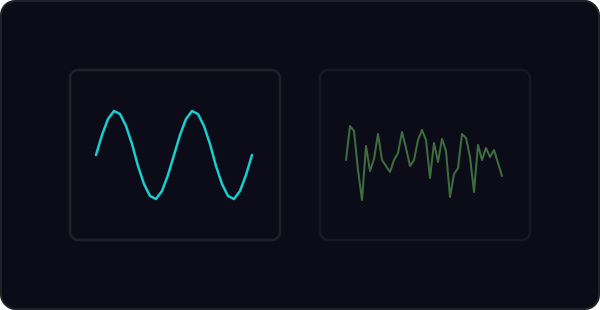
The focus score is built from gamma waves, the fast ones, 30 to 44 Hz. The problem is that clenching your jaw or scrunching your forehead produces electrical noise in that same frequency range, and the headset cannot reliably tell “muscle” from “brain” up there. So a high focus score can mean you were tense rather than focused.
The calm score is built from alpha waves, 7.5 to 12.5 Hz. Those are slower, far more stable, and much less exposed to muscle. EMG power climbs steeply with frequency and dominates the scalp signal above about 20 Hz, which is exactly where the focus band sits (Whitham et al. 2007). Even a weak brow or jaw contraction can still reach down into the alpha band and obscure or mimic the rhythms there (Goncharova et al. 2003), so the difference is one of degree rather than immunity. Alpha is also the most prominent rhythm in resting human scalp EEG (Barzegaran et al. 2017), which is what makes it the most practical thing for a headset like this to track. So between the two scores Neurosity hands you, I’d trust calm first and treat focus as unconfirmed until you’ve ruled out muscle.
One of my own trials fits this exactly. I trained bitingALemon, which is a jaw clench, and recorded it 31 times. A jaw clench lands in the same gamma range the focus score reads from: a clean demonstration of a “brain” signal that’s really a muscle.
Worth knowing: That last step, “so trust calm over focus,” is my own conclusion, not something Neurosity says. If you want to prove it on your own headset: record one session where you alternate deliberately clenching your jaw with genuinely concentrating. If focus spikes on the clenches, there’s your answer.
Sources
My own data: three recorded console sessions (248,320 samples), including 31 recorded bitingALemon jaw-clench trials, and an audit of seventeen training experiments.
- Neurosity documentation: Focus and Calm, for both bands and the 0.3 threshold
- Whitham, E. M. et al. (2007). Scalp electrical recording during paralysis. Clinical Neurophysiology 118(8):1877-1888.
- Goncharova, I. I. et al. (2003). EMG contamination of EEG. Clinical Neurophysiology 114(9):1580-1593.
- Barzegaran, E., Vildavski, V. Y., and Knyazeva, M. G. (2017). Fine Structure of Posterior Alpha Rhythm in Human EEG. Scientific Reports 7:8249.