Neurosity’s own documentation covers the official side, the numbers, the API, the setup, at docs.neurosity.co. This page covers what the documentation doesn’t: the things I wish someone had handed me first.
Four things, and a picture
Read these and the rest of the page makes sense.
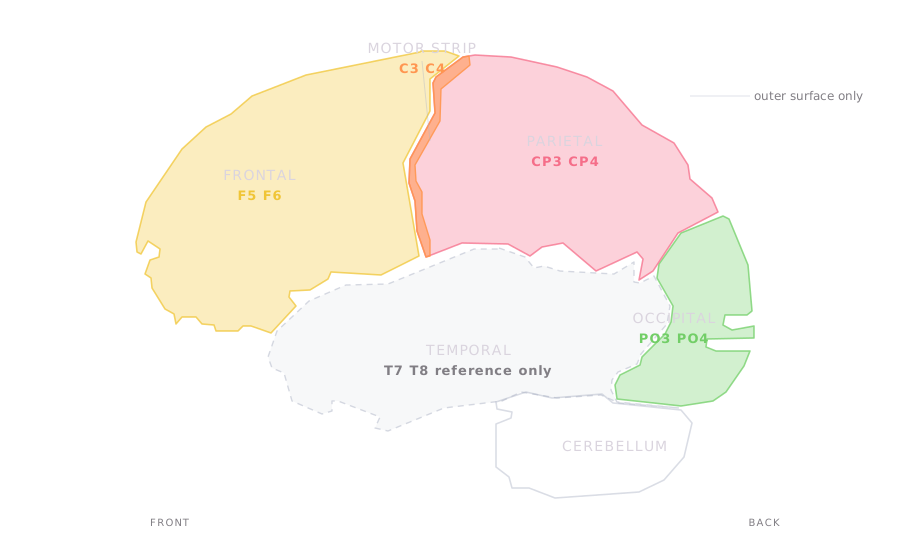
A rough map, not an anatomy lesson. The headset only reaches the outer surface, so anything deeper is invisible to it. Each region is coloured with the channels that sit over it, the same colours the legend below uses. Temporal is left grey because T7 and T8 are reference sensors and record nothing. Anatomy traced from Blausen.com staff (2014). “Medical gallery of Blausen Medical 2014.” WikiJournal of Medicine 1(2):10. doi:10.15347/wjm/2014.010. ISSN 2002-4436. CC BY 3.0.
- Front, F5 and F6. Thinking, attention, decisions. Most likely where the focus score comes from.
- Motor strip, C3 and C4. Planning movement. Each side runs the opposite hand.
- Parietal, CP3 and CP4. Body awareness, spatial sense.
- Back, PO3 and PO4. Vision, and most likely the calm score.
- Sides, no data. T7 and T8 sit here but the headset uses them for reference, not recording.
Sources
My own data: three recorded console sessions (248,320 samples), an audit of seventeen training experiments, and the Notion console and sensor references.
- Neurosity documentation: Focus and Calm, for the two bands, the 0.3 threshold, and the 16-second initialisation
- Berger, H. (1929). Über das Elektrenkephalogramm des Menschen. Archiv für Psychiatrie und Nervenkrankheiten 87:527-570.
- Barry, R. J. et al. (2007). EEG differences between eyes-closed and eyes-open resting conditions. Clinical Neurophysiology 118(12):2765-2773.
- Nayak, C. S., and Anilkumar, A. C. EEG Normal Waveforms. StatPearls.