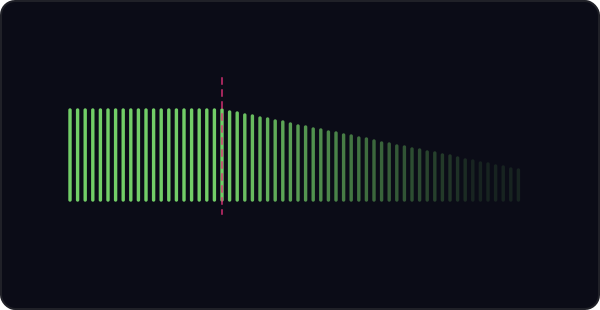
The biggest session I ran was 60 trials of mental math. My own note from that day: I was tired by around trial 20. I stopped generating fresh equations and started thinking the words instead, and I couldn’t properly rest between trials because I was still mid-calculation. So the back half of my biggest dataset is a different task than the front half, with messy rest in between.
Trial 20 is my number, not a general finding. What I noticed was a change in how I was doing the task, not a drop in a score. Published work puts mental fatigue staying low for roughly the first 100 trials before it rises sharply, and reports that fatigue significantly reduced imagery recognition rate (Li et al. 2024). A separate study found subjective fatigue rising steadily across 400 trials while decoding performance stayed flat (Li et al. 2021). My observation is compatible with both. The useful conclusion is not “stop at 20,” it is that the point where your own quality falls off is something you have to find out for yourself, and then design around.
There is nowhere to write any of this down
The console has no field for a note against a trial. There is no way to log that a door slammed on trial 14, that the band shifted on trial 22, or that I lost the thread somewhere in the twenties. After a certain point in a long run I could no longer account for what was skewing which trials, and because the trials are not inspectable afterwards (finding 03), the context is gone permanently. The count survives. Everything that would let you interpret the count does not.
The hardware makes sitting through a long session harder than it sounds
The Crown reads through dry electrodes resting on the scalp, and slight movement is enough to shift a node off the patch it was reading, or to break contact with it altogether. That does not announce itself as a failure. It arrives as a misread. On top of that, a jaw clench alone puts electrical noise straight into the band the focus score is built from, and EMG from the jaw and brow muscles is largest at the scalp periphery closest to the muscle (Goncharova et al. 2003).
So the practical instruction becomes: sit extremely still, do not talk, do not adjust the band, do not clench. Holding that posture is work. Across a long session the effort of staying still is competing for attention with the task you are supposed to be imagining, and both of them degrade together.
The number this collides with
There is an arithmetic problem sitting between that observation and the experiment I would most like to run next. The mentalMath experiment holds 60 trials, double every other session in my log, and it is the one where I noted the drop-off. Fatigue arrived at roughly trial 20, in a session designed for 30 per label.
A two-class session asks for more than that. Thirty trials of one command and thirty of another, recorded in the same sitting so that the cap placement is identical, is 60 trials in one go: three times past the point where my own notes say the quality fell away. So the protocol I would recommend and the fatigue I actually measured are in tension, and the honest resolution is to split it. Twenty per class, repeated across days, gives better data than sixty in one afternoon, and the multi-day evidence below says the same thing from the other direction.
What would help next time
Cap a single imagery block at about 30 minutes. In a study of long motor imagery runs, fatigue stayed low through roughly the first 100 trials and then rose sharply, and the authors put the optimal training block at 100 to 150 trials with the duration controlled within 30 minutes (Li et al. 2024). Decide the stop before you start and let the clock end the run rather than your patience.
Spread the same total trials across days instead of extending one sitting. In a multi-day two-class hand imagery dataset of 51 participants, accuracy was lowest in the first session (81.77%) and highest in the third, recorded on a different day (88.90%) (Yang et al. 2025). The general learning literature points the same way: distributed practice beat massed practice with a moderate effect (d = 0.54) across 22 reports and more than 3,000 participants (Mawson and Kang 2025). That second one studied classroom learning, not imagery, so take it as the principle and take Yang et al. as the evidence that it holds for this specific task.
Put a real break between runs, and make it long enough to count. A meta-analysis of micro-breaks found reliable gains in vigour (d = .36) and reductions in fatigue (d = .35). The performance effect across all tasks was small and did not reach significance (d = .16), but break length moderated it: the longer the break, the greater the boost (Albulescu et al. 2022). The gap between trials is not a break. Schedule the break separately and make it generous.
Write down how you felt at the end of every run, in your own file. Across 400 trials in sessions of more than an hour, general fatigue, mental fatigue and distress all rose and engagement fell, while decoding performance showed no significant change (Li et al. 2021). Feeling fine is not evidence that the data is fine, and feeling wrecked is not evidence that it is ruined. The two move independently, which is exactly why the subjective rating is worth capturing rather than assuming. Since the console will not hold it, keep a plain text log beside the session: run number, what interrupted you, how tired you were out of ten.
Use theta as a rough, self-relative fatigue check. Theta power rose significantly once mental fatigue set in during imagery, and the authors propose the theta bands of the frontal, central and parieto-occipital clusters as biomarkers for monitoring fatigue during motor imagery (Li et al. 2024). The Crown already streams band power, so theta at F5, F6, C3 and C4 can be watched across a session and used to decide when to stop, instead of finishing the planned trial count on principle. Keep it relative to your own earlier minutes in the same session, and take it no further than that. It is a stopping cue, not a measurement of a person.
Try this instead: 20 to 30 trials per command per sitting, a hard stop at 30 minutes, a proper break between runs, and the rest of the plan on another day. Keep a note file open beside the session for everything the console has nowhere to put.
Sources
My own data: three recorded console sessions (248,320 samples), an audit of seventeen training experiments, and the Notion console and sensor references.
- Li, T. et al. (2024). Research on mental fatigue during long-term motor imagery. Scientific Reports 14:18454.
- Li, S. et al. (2021). Exploring Fatigue Effects on Performance Variation of Intensive Brain-Computer Interface Practice. Frontiers in Neuroscience 15:773790.
- Yang, B. et al. (2025). A multi-day and high-quality EEG dataset for motor imagery brain-computer interface. Scientific Data 12:488.
- Mawson, R. D., and Kang, S. H. K. (2025). The Distributed Practice Effect on Classroom Learning. Behavioral Sciences 15(6):771.
- Albulescu, P. et al. (2022). “Give me a break!” A systematic review and meta-analysis on the efficacy of micro-breaks. PLOS ONE 17(8):e0272460.
- Goncharova, I. I. et al. (2003). EMG contamination of EEG. Clinical Neurophysiology 114(9):1580-1593.