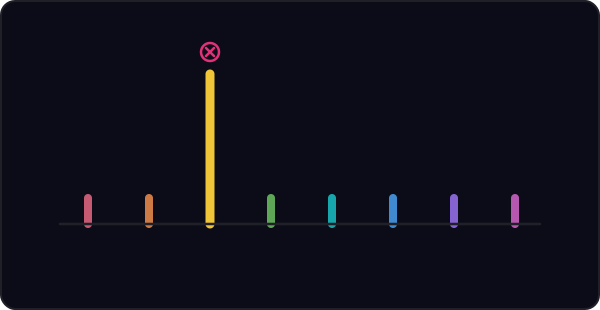
If one sensor’s signal is far bigger than the others, that’s not a more active part of the brain, it’s a sensor that isn’t sitting right. That one check caught a bad channel (F5) running 26 times louder than the rest in one of my sessions, before I built anything on top of it.
Two related things people get wrong. First, a large baseline offset (a number sitting far from zero) is normal and not a fault. What matters is how much the signal moves, not where it sits. Second, the slowest band (delta) is always the biggest, 72 to 95% of everything, because it’s mostly drift, breathing, and small movements. So band numbers only make sense compared between recordings, never as absolute values.
The rule underneath all of this: Bad contact still produces confident-looking numbers. Check signal quality before you trust anything, or you’ll build something that’s convincingly wrong.
Sources
My own data: three recorded console sessions (248,320 samples), an audit of seventeen training experiments, and the Notion console and sensor references.
- Goncharova, I. I. et al. (2003). EMG contamination of EEG. Clinical Neurophysiology 114(9):1580-1593., for why contamination is largest at the scalp positions nearest an active muscle