A short briefing before the detail. This page covers one thing: the evidence under the calm score, and what that evidence is good for if you are the next person building on a Crown. It comes first because most of what this site claims rests on it.
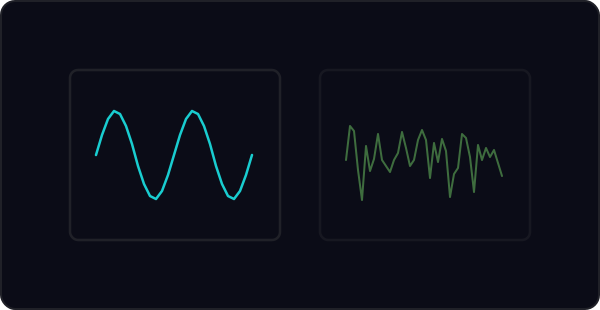
If you are starting a project on this headset, start with alpha, the 7.5 to 12.5 Hz band the calm score is built from. Research shows it’s the most defensible ground the hardware gives you: posterior alpha is the most prominent activity in resting human scalp EEG, it is the first electrical activity anyone recorded from a human head, and it moves by roughly 40% between eyes closed and eyes open. That gives you two things you can act on immediately: a signal worth building a feature on, and a one-minute test that tells you whether your fit, your recording path and your analysis are all working before you spend a day on anything else.
The research. A 2018 review of the EEG literature on meditation (Lee et al., Frontiers in Neuroscience) found that alpha activity increases in posterior brain regions during both focused-attention and open-monitoring meditation, and that theta increases appear across a variety of practices, scaling with training. A single study makes it concrete: Lagopoulos et al. recorded experienced practitioners during nondirective meditation and found significantly increased theta and alpha compared with quiet rest. This is a well-replicated body of work, which is the whole reason it is safe to build on.
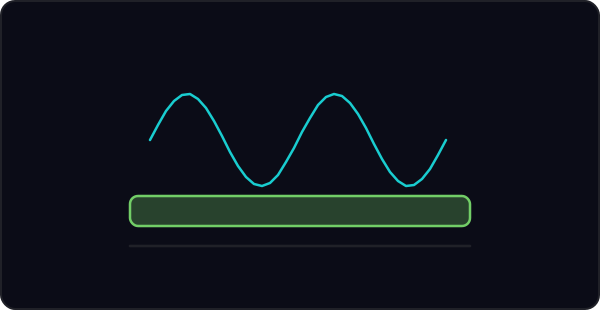
What to build on it. Calm is built from alpha, and the posterior sensors PO3 and PO4 sit over exactly the regions where meditation alpha shows up. My own sessions matched the published pattern: alpha at PO4 climbed from 6.1% to 29.7% of signal share across a five-minute wind-down. If you are choosing what your product reacts to, choose this. A calm-driven feature is standing on decades of replication; a focus-driven one is standing on a 30 to 44 Hz band that dry electrodes let jaw and brow muscle into. Read theta alongside alpha rather than alpha on its own, because the two rising together is the meditation pattern while theta climbing as alpha falls away is the direction of drowsiness.
The eyes-closed test
Record 30 seconds with your eyes open, then 30 seconds with them closed, and compare alpha at PO3 and PO4. If it does not rise, stop and fix the setup before you trust anything else the headset tells you.
This is the cheapest check in the whole field and it is worth its own heading, because it validates the entire chain in one minute: electrode contact, the recording path, your band maths, and your own assumption about which numbers mean what. Nothing downstream is worth debugging until this passes. It works because the posterior alpha rhythm is the largest, most reliable thing an electrode over the back of the head can see, and closing your eyes is the simplest way anyone has found to make it change on command.
Run it at the start of a session rather than once at the beginning of a project. Fit drifts, hair moves, and a headset that passed yesterday is not evidence about today. If the result comes out flat, run it a second time before blaming the hardware: standard clinical descriptions note that a minority of perfectly healthy adults have a low-voltage background with little measurable alpha, so a flat trace is occasionally a person rather than a fault. The beginner’s version of this test, with the numbers, is in the primer.
The honest limit. The studies behind this used research-grade equipment and, often, experienced meditators. Eight dry electrodes see posterior alpha well, which is fortunate, because it is the best-replicated part of the literature, and that is where the good luck ends. The reviews are not unanimous on every detail. What the evidence supports is a design decision, which signal to build on, and not a claim about what any individual session means.
Sources
My own data: three recorded console sessions (248,320 samples) and the Crown Signal Reader analysis.
- Berger, H. (1929). Über das Elektrenkephalogramm des Menschen. Archiv für Psychiatrie und Nervenkrankheiten 87:527-570.
- Barzegaran, E., Vildavski, V. Y., and Knyazeva, M. G. (2017). Fine Structure of Posterior Alpha Rhythm in Human EEG. Scientific Reports 7:8249.
- Barry, R. J. et al. (2007). EEG differences between eyes-closed and eyes-open resting conditions. Clinical Neurophysiology 118(12):2765-2773.
- Lee, D. J. et al. (2018). Review of the Neural Oscillations Underlying Meditation. Frontiers in Neuroscience 12:178.
- Lagopoulos, J. et al. (2009). Increased Theta and Alpha EEG Activity During Nondirective Meditation. Journal of Alternative and Complementary Medicine 15(11):1187-1192.
- Lomas, T., Ivtzan, I., and Fu, C. H. Y. (2015). A systematic review of the neurophysiology of mindfulness on EEG oscillations. Neuroscience and Biobehavioral Reviews 57:401-410.
- Nayak, C. S., and Anilkumar, A. C. EEG Normal Waveforms. StatPearls., for the low-voltage caveat on the eyes-closed test
- Nayak, C. S., Sankari, A., and Anilkumar, A. C. EEG Normal Sleep. StatPearls., for the alpha to theta direction at sleep onset